
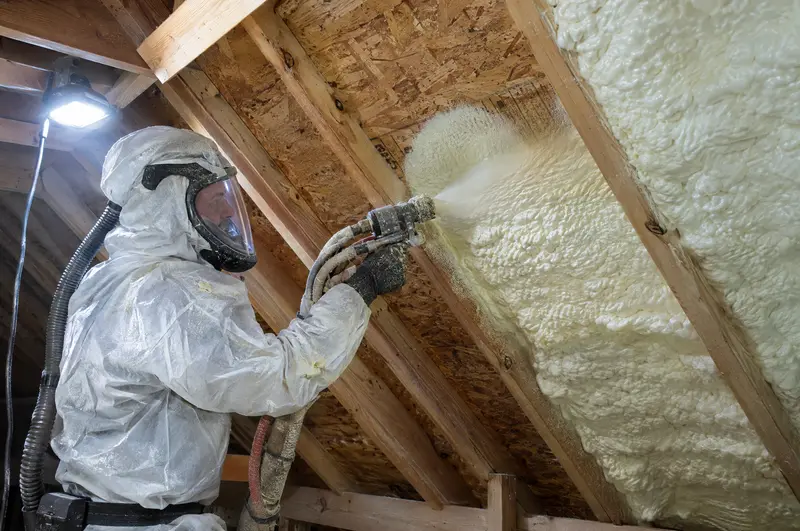
Spray foam expands to fill every crack and cavity it touches, so it insulates and air seals in a single step. It is the right tool for parts of a house where loose-fill cannot go: cathedral and vaulted ceilings, the underside of a roof deck, bonus rooms over garages, rim joists and open wall cavities in remodels.
Open-cell vs. closed-cell
Open-cell foam is softer and lighter, a good air seal, and it dampens sound, which is why it is common on roof decks and interior walls. Closed-cell foam is denser, has a higher R-value per inch and adds rigidity and moisture resistance, so it works well in tight spaces and on exterior walls. We will explain which one suits each area of your home.
Turning the attic into conditioned space
Foaming the underside of the roof deck brings the attic inside your home's thermal envelope. If your HVAC unit and ducts live in the attic, they then sit in mild air instead of 140°F heat. It costs more than a blown-in floor, so we only recommend it when that trade-off makes sense for your house.
Safe, clean installation
Our installers wear full protective gear and ventilate the work area. We mask surfaces, keep the foam off wiring boxes and vents, and ask you to stay out of the home while the foam cures. When we are done, the area is trimmed, cleaned and ready to close up.
Signs you could use this
- You have vaulted or cathedral ceilings with no attic above
- A bonus room or room over the garage is always too hot or too cold
- Your HVAC and ducts sit in a hot attic
- You are remodeling and the walls are open
- You want insulation and air sealing in one step
Where we offer spray foam insulation
We provide spray foam insulation across San Fernando Valley, Burbank, Glendale & Pasadena, Los Angeles & the Westside, Santa Clarita & Antelope Valley and Conejo Valley & Simi Valley, including: